NextGen UBE Abbreviations
Share
The UBE system uses several standardized abbreviations that refer to the institutions, exams, and legal sources commonly encountered in bar preparation and legal practice. These abbreviations identify key organizations such as the NCBE and ABA, major components of the bar exam including the MBE, MEE, and MPT, and important legal authorities such as the UCC, MPC, FRCP, and FRE. These terms frequently appear in study materials, exam questions, and legal writing, so it is important to familiarize yourself with them for effective preparation of the UBE.
1L (First-Year Law Student)
A 1L refers to a first-year student in a Juris Doctor program at a U.S. law school. During the first year, students typically study core foundational subjects such as contracts, torts, civil procedure, criminal law, property, and legal writing. The 1L year is considered the most structured and academically demanding part of law school.
2L (Second-Year Law Student)
A 2L is a second-year law student who has completed the foundational first-year curriculum. During this year, students usually begin taking elective courses, participate in activities such as law review or moot court, and gain practical experience through internships or clinical programs.
3L (Third-Year Law Student)
A 3L refers to a third-year law student in the final year of the JD program. Students often focus on specialized courses, bar-tested subjects, and experiential learning opportunities such as legal clinics or externships. The 3L year is also a time when students begin preparing for the bar examination and planning their legal careers.
4A (Fourth Amendment)
The Fourth Amendment to the United States Constitution protects individuals from unreasonable searches and seizures by the government. It generally requires law enforcement officers to obtain a warrant supported by probable cause before conducting a search or seizure, subject to certain recognized exceptions.
5A (Fifth Amendment)
The Fifth Amendment provides several important protections in criminal and civil proceedings. These include the right against self-incrimination, the guarantee of due process of law, protection against double jeopardy, and the requirement that private property not be taken for public use without just compensation.
6A (Sixth Amendment)
The Sixth Amendment guarantees rights to individuals accused of crimes in criminal prosecutions. These rights include the right to a speedy and public trial, the right to an impartial jury, the right to be informed of the charges, the right to confront witnesses, and the right to assistance of counsel.
8A (Eighth Amendment)
The Eighth Amendment prohibits the federal and state governments from imposing excessive bail, excessive fines, or cruel and unusual punishments. This amendment is commonly applied in cases involving sentencing, prison conditions, and the constitutionality of certain punishments.
14A (Fourteenth Amendment)
The Fourteenth Amendment extends constitutional protections to actions by state governments. It includes the Due Process Clause and the Equal Protection Clause, which guarantee fair legal procedures and prohibit states from denying equal protection of the laws. Many provisions of the Bill of Rights have been applied to the states through this amendment.
ABA (American Bar Association)
The American Bar Association is the largest voluntary professional organization of lawyers in the United States. It plays an important role in shaping the legal profession by accrediting law schools, developing model rules and standards for legal practice, and promoting improvements in the administration of justice. Although the ABA does not regulate lawyers directly, its standards strongly influence legal education and professional conduct rules adopted by states.
C&F (Character and Fitness)
Character and Fitness refers to the background investigation conducted before an applicant is admitted to the bar. The review evaluates whether a candidate possesses the honesty, integrity, and responsibility necessary to practice law. It typically examines factors such as criminal history, academic discipline, financial responsibility, and professional conduct.
CFR (Code of Federal Regulations)
The Code of Federal Regulations is the official compilation of rules and regulations issued by federal administrative agencies of the United States government. These regulations implement and interpret federal statutes enacted by Congress. The CFR is organized into subject titles and is updated annually to reflect current federal regulatory law.
CISG (Convention on the International Sale of Goods)
The CISG is an international treaty governing contracts for the sale of goods between parties located in different countries that are signatories to the treaty. It provides uniform rules for international commercial transactions and may occasionally appear in discussions of contract law, although domestic U.S. law generally applies unless the parties are engaged in international trade covered by the convention.
CLE (Continuing Legal Education)
Continuing Legal Education refers to educational programs that licensed attorneys must complete after admission to the bar in order to maintain professional competence. These programs help lawyers stay informed about changes in the law and developments in legal practice.
FRAP (Federal Rules of Appellate Procedure)
The Federal Rules of Appellate Procedure establish the procedures for appeals in the federal court system. They govern the filing of appeals, preparation of records, briefing requirements, and oral argument procedures in federal appellate courts.
FRCrP (Federal Rules of Criminal Procedure)
The Federal Rules of Criminal Procedure govern the procedures used in federal criminal prosecutions. They regulate matters such as arrest, indictment, plea procedures, trials, sentencing, and appeals in federal criminal courts.
FRE (Federal Rules of Evidence)
The Federal Rules of Evidence govern the admissibility of evidence in federal courts. These rules establish standards for determining what evidence may be presented at trial, including rules concerning relevance, hearsay, privileges, character evidence, and witness testimony. Although the FRE apply directly to federal courts, many states have adopted evidence rules that closely resemble them.
FRCP (Federal Rules of Civil Procedure)
The Federal Rules of Civil Procedure regulate the procedures used in civil litigation in United States federal courts. They govern issues such as pleadings, motions, discovery, trial procedure, and judgment. These rules aim to ensure the fair, efficient, and consistent resolution of civil disputes in the federal court system.
GP (General Partnership)
A general partnership is a business entity formed when two or more persons agree to carry on a business for profit as co-owners. In a general partnership, each partner typically has the authority to bind the partnership and shares in the management of the business. Partners are also personally liable for the debts and obligations of the partnership.
IIED (Intentional Infliction of Emotional Distress)
Intentional Infliction of Emotional Distress is a tort that occurs when a defendant intentionally or recklessly engages in extreme and outrageous conduct that causes severe emotional distress to another person. It is commonly tested in tort law on the bar examination.
JD (Juris Doctor)
The Juris Doctor is the primary professional law degree in the United States and is typically required to sit for the bar examination. The degree is usually earned after three years of study at an accredited law school.
LLB (Bachelor of Laws)
The Bachelor of Laws is the traditional law degree awarded in many countries outside the United States. Foreign lawyers who hold an LLB may sometimes qualify to take a U.S. bar exam after completing additional legal education in the United States.
LLM (Master of Laws)
The Master of Laws is an advanced law degree that allows lawyers to specialize in a particular area of law or to gain familiarity with U.S. legal principles. Foreign-trained lawyers often pursue an LLM in the United States in order to become eligible to take certain state bar examinations.
LLC (Limited Liability Company)
A limited liability company is a business structure that combines elements of partnerships and corporations. Members of an LLC generally enjoy limited liability, meaning they are not personally responsible for the company’s debts and obligations. At the same time, the LLC provides flexibility in management and taxation, making it a popular form of business organization.
LLP (Limited Liability Partnership)
A limited liability partnership is a form of partnership in which partners are protected from personal liability for certain obligations of the partnership, particularly those arising from the misconduct or negligence of other partners. LLPs are commonly used by professional firms such as law firms and accounting firms.
LSAC (Law School Admission Council)
The Law School Admission Council is the organization responsible for administering the Law School Admission Test and managing many aspects of the law school admissions process in the United States. It provides services such as credential evaluation and application processing for law school applicants.
LSAT (Law School Admission Test)
The Law School Admission Test is a standardized examination used by many law schools in the United States as part of the admissions process for Juris Doctor programs. Administered by the Law School Admission Council, the test measures skills considered essential for legal study, including logical reasoning, analytical reasoning, and reading comprehension.
MBE (Multistate Bar Examination)
The Multistate Bar Examination is a standardized multiple-choice test used in many U.S. jurisdictions as part of the bar examination. Developed by the National Conference of Bar Examiners, the MBE assesses knowledge of fundamental legal subjects such as constitutional law, contracts, criminal law, evidence, real property, and torts.
MEE (Multistate Essay Examination)
The Multistate Essay Examination consists of essay questions designed to test a candidate’s ability to analyze legal issues, apply legal principles, and communicate legal reasoning in writing. The exam covers a variety of subjects including business associations, civil procedure, contracts, criminal law, evidence, and trusts and estates.
MCLE (Mandatory Continuing Legal Education)
Mandatory Continuing Legal Education refers to the requirement imposed by most state bars that attorneys complete a specific number of continuing education hours each year or reporting period. These programs ensure that lawyers maintain professional competence throughout their careers.
MJP (Multijurisdictional Practice)
Multijurisdictional Practice refers to the practice of law across state lines. Ethical rules govern when lawyers licensed in one state may provide legal services in another state, particularly in situations involving temporary practice or federal matters.
MPC (Model Penal Code)
The Model Penal Code is a comprehensive model statute developed by the American Law Institute to modernize and standardize criminal law in the United States. Although it is not binding law itself, many states have adopted provisions from the Model Penal Code when drafting or revising their criminal statutes.
MPRE (Multistate Professional Responsibility Examination)
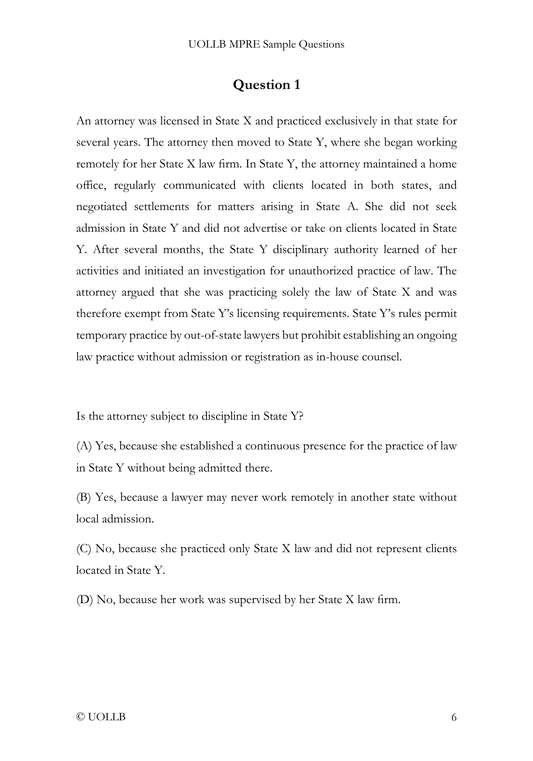
The Multistate Professional Responsibility Examination is a standardized test that measures knowledge and understanding of the ethical standards governing lawyers. The exam focuses on the duties of lawyers to clients, courts, and the legal profession, and it is required for admission to the bar in most U.S. jurisdictions.
MPT (Multistate Performance Test)
The Multistate Performance Test evaluates a candidate’s practical lawyering skills rather than memorized legal knowledge. Examinees are given a file containing factual materials and legal authorities and must complete tasks such as drafting memoranda or briefs. The test measures abilities such as legal analysis, problem-solving, and written communication.
MRPC (Model Rules of Professional Conduct)
The Model Rules of Professional Conduct are ethical guidelines developed by the American Bar Association to regulate the professional behavior of lawyers. Although they are not binding on their own, most U.S. states have adopted versions of these rules to govern attorney conduct, including duties relating to confidentiality, conflicts of interest, and client representation.
MCJC (Model Code of Judicial Conduct)
The Model Code of Judicial Conduct is a set of ethical rules for judges and judicial candidates created by the American Bar Association. It establishes standards of behavior designed to preserve judicial integrity, impartiality, and independence. Although the Code itself is not binding law, many U.S. states adopt it (often with modifications) as the basis for their own judicial ethics rules.
NCBE (National Conference of Bar Examiners)
The National Conference of Bar Examiners is a nonprofit organization responsible for developing standardized tests used in the bar admission process. The NCBE creates and administers exams such as the MBE, MEE, MPT, and MPRE, and it also coordinates the Uniform Bar Examination used by many U.S. jurisdictions.
NextGen UBE (Next Generation Uniform Bar Examination)
The NextGen Uniform Bar Examination is a redesigned bar exam developed by the National Conference of Bar Examiners to replace the current Uniform Bar Examination. Beginning with its first administration in July 2026 in some jurisdictions, the NextGen UBE focuses more heavily on practical lawyering skills, integrated legal analysis, and real-world legal tasks. The new exam aims to better assess whether candidates possess the knowledge and professional skills necessary to begin practicing law effectively.
NIED (Negligent Infliction of Emotional Distress)
Negligent Infliction of Emotional Distress is a tort that arises when a defendant’s negligent conduct causes serious emotional harm to another person. Courts typically require additional elements, such as physical symptoms or a close relationship to the injured party, depending on the jurisdiction.
RPC (Rules of Professional Conduct)
Rules of Professional Conduct refer to the ethical rules adopted by each state to regulate the behavior of lawyers. These rules are generally based on the ABA Model Rules of Professional Conduct but may vary slightly from state to state.
RSC (Restatement (Second) of Contracts)
The Restatement (Second) of Contracts is a highly influential legal treatise published by the American Law Institute that summarizes the principles of common law contract doctrine. Although it is not binding law, courts frequently rely on it as persuasive authority.
RST (Restatement (Second) of Torts)
The Restatement (Second) of Torts is a secondary legal authority that organizes and explains the principles governing tort liability. Like other Restatements, it is not binding but is widely cited by courts and used in legal education and bar exam preparation.
SCOTUS (Supreme Court of the United States)
SCOTUS refers to the Supreme Court of the United States, the highest court in the federal judicial system. The Court has ultimate authority to interpret the U.S. Constitution and federal law. Its decisions are binding on all lower federal and state courts.
SJD / JSD (Doctor of Juridical Science)
The Doctor of Juridical Science, sometimes called the JSD or SJD, is the highest academic degree in law and is similar to a PhD in legal studies. It is primarily pursued by scholars who intend to work in academia or advanced legal research rather than legal practice.
UCC (Uniform Commercial Code)
The Uniform Commercial Code is a comprehensive set of model laws governing commercial transactions in the United States. It regulates areas such as sales of goods, negotiable instruments, secured transactions, and bank deposits. Although it is a model code, it has been adopted with some modifications by all U.S. states.
UBE (Uniform Bar Examination)
The Uniform Bar Examination is a standardized bar exam developed by the National Conference of Bar Examiners and adopted by many U.S. jurisdictions. It consists of three components: the Multistate Bar Examination, the Multistate Essay Examination, and the Multistate Performance Test. Scores earned on the UBE may be transferred between participating jurisdictions.
USC (United States Code)
The United States Code is the official codification of the general and permanent federal statutes of the United States. It organizes laws enacted by Congress into subject titles, making federal legislation easier to locate and apply. Courts frequently cite the USC when interpreting federal statutory law.