Model Rules of Professional Conduct (MRPC)
Share
The Model Rules of Professional Conduct (MRPC) were adopted by the ABA House of Delegates in 1983. They serve as models for the ethics rules of most jurisdictions. Before the adoption of the Model Rules, the ABA model was the 1969 Model Code of Professional Responsibility. The MRPC is organized into eight major categories of rules (numbered 1 through 8), each of which contains individual rules numbered using a decimal point. In addition to the text of the rules, each rule is followed by a series of "Comments" which are not rules per se, but provide guidance to help attorneys interpret the rules.
RULES
Rule 1.0: Terminology
MRPC terminology provides essential definitions to ensure clarity and consistency in interpretation. It defines key terms such as “informed consent,” which requires a lawyer to communicate adequate information and explanation to allow a client to make knowledgeable decisions; “confirmed in writing,” which means informed consent is documented either in a written form or promptly recorded; and distinctions between terms like “screened” and “reasonably believes” that relate to conflicts of interest and a lawyer’s state of mind. The rule also defines the terms “firm” or “law firm,” making clear that the context, including structure and operational integration, determines whether lawyers are considered a single firm for ethical purposes. These definitions underpin the entire MRPC framework, helping lawyers apply ethical standards consistently across various professional scenarios.
CLIENT-LAWYER RELATIONSHIP
Rule 1.1: Competence
A lawyer must provide competent representation, which means having the legal knowledge, skill, thoroughness, and preparation reasonably necessary for the matter. Competence is an ongoing duty, not a fixed threshold achieved at bar admission. A lawyer can become competent in a new area by studying the law or associating with someone who already has the needed expertise.
Rule 1.2: Scope of Representation and Allocation of Authority
A lawyer shall abide by a client's decisions concerning the objectives of representation and, as required by Rule 1.4, shall consult with the client as to the means by which they are to be pursued. A lawyer may take such action on behalf of the client as is impliedly authorized to carry out the representation. Clients control the goals; lawyers control the strategy. Importantly, a lawyer may not assist a client in criminal or fraudulent conduct, but may advise the client about the legal consequences of any proposed course of action.
Rule 1.3: Diligence
A lawyer must act with reasonable diligence and promptness in representing a client. This means following through on matters, meeting deadlines, and not letting cases sit idle. Neglect and procrastination are among the most common reasons clients file bar complaints against their lawyers.
Rule 1.4: Communications
A lawyer must keep the client reasonably informed about the status of the matter, promptly respond to requests for information, and explain things clearly enough for the client to make informed decisions. This rule applies throughout the representation. A lawyer cannot simply go quiet when things are going badly.
Rule 1.5: Fees
The basis or rate of the fee and expenses for which the client will be responsible shall be communicated to the client, preferably in writing, before or within a reasonable time after commencing the representation. Fees must be reasonable, taking into account factors like time, complexity, experience, and the customary fee in the area. Contingency fee agreements must be in writing. Contingency fees are prohibited in criminal cases and domestic relations matters where the fee depends on obtaining a divorce or property settlement.
Rule 1.6: Confidentiality of Information
A lawyer shall not reveal information relating to the representation of a client unless the client gives informed consent, the disclosure is impliedly authorized in order to carry out the representation, or the disclosure is permitted by the exceptions in the rule. The duty is broader than the attorney-client privilege and covers all information relating to the representation regardless of the source, and it survives the end of the representation. Permissive exceptions include disclosures to prevent certain serious crimes or frauds and to defend against claims by the client.
Rule 1.7: Conflict of Interest (Current Clients)
A lawyer cannot represent a client if the representation is directly adverse to another current client, or if there is a significant risk that representing one client will materially limit the lawyer's ability to represent another. Both conflicts can be waived if the lawyer reasonably believes they can competently represent all affected clients and each gives informed written consent. This is the foundational conflicts rule.
Rule 1.8: Conflict of Interest (Specific Rules)
This rule covers specific prohibited transactions with current clients, including: entering into business transactions with clients on unfair terms, using confidential information against a client's interests, receiving gifts from clients (beyond token items), providing financial assistance to a client in litigation (other than advancing costs), and acquiring a proprietary interest in the subject of litigation. Sexual relationships with clients are also prohibited unless a prior consensual relationship existed before the representation began.
Rule 1.9: Duties to Former Clients
A lawyer who previously represented a client cannot switch sides and represent a new client in the same or a substantially related matter if the new client's interests are materially adverse to the former client. This protects the confidential information the lawyer learned during the prior representation. A former client can waive this restriction with informed consent.
Rule 1.10: Imputed Disqualification
When one lawyer in a firm has a conflict of interest, that conflict is generally imputed to every other lawyer in the firm. This means none of them can take on the conflicted matter. The rule protects the confidentiality of former clients by preventing any member of the firm from exploiting information learned in a prior representation. Screening can sometimes cure the imputation when the conflict arose from a lateral hire.
Rule 1.11: Special Conflicts for Former and Current Government Officers and Employees
A former government lawyer cannot represent a private party in connection with a matter in which the lawyer personally and substantially participated while in government, unless the government agency consents. Current government lawyers have a reciprocal duty not to participate in matters involving former clients. These rules manage the "revolving door" between government and private practice.
Rule 1.12: Former Judge, Arbitrator, Mediator, or Other Third-Party Neutral
A lawyer who served as a judge or neutral cannot later represent anyone in connection with a matter in which they personally and substantially participated. The lawyer's conflict can sometimes be cured by screening within a new firm so the conflict is not imputed to all colleagues. This rule prevents the exploitation of information and relationships gained while serving in a neutral capacity.
Rule 1.13: Organization as Client
When a lawyer represents a corporation or other organization, the client is the organization itself, not its individual officers, directors, or employees. If the lawyer learns that someone within the organization is acting in a way that violates legal obligations and could cause harm to the organization, the lawyer must report it up the chain of command within the organization, up to and including the board of directors.
Rule 1.14: Client with Diminished Capacity
When a client has diminished capacity due to age, illness, or disability, the lawyer must still treat the client with respect and attempt to maintain a normal client-lawyer relationship as much as possible. When taking protective action, the lawyer is impliedly authorized to reveal information about the client, but only to the extent reasonably necessary to protect the client's interests. In extreme cases the lawyer may seek appointment of a guardian.
Rule 1.15: Safekeeping Property
A lawyer must keep client funds and property separate from the lawyer's own funds. Client money must be held in a dedicated trust account. The lawyer must promptly notify the client upon receiving funds or property, keep accurate records, and promptly deliver what belongs to the client. Mishandling client funds is one of the most serious violations of the rules and one of the most common causes of disbarment.
Rule 1.16: Declining or Terminating Representation
A lawyer must withdraw from a representation if continued representation would violate the rules of professional conduct, if the lawyer is discharged by the client, or if the client's mental condition makes the representation impossible. A lawyer may withdraw for other reasons, such as non-payment of fees, as long as withdrawal does not cause material harm. Upon termination, the lawyer must take steps to protect the client's interests, such as returning the file and any unearned fees.
Rule 1.17: Sale of Law Practice
A lawyer may sell their law practice, including the goodwill, under certain conditions. The seller must give written notice to each affected client, and clients must be given the opportunity to consent to the transfer or to retain other counsel. The purchase price may be based on a percentage of future fees generated, and the entire practice (or an entire area of practice) must be sold. A lawyer cannot cherry-pick which clients to sell.
Rule 1.18: Duties to Prospective Clients
A person who consults with a lawyer about possible representation, even if no engagement follows, is a prospective client. The lawyer cannot use or reveal confidential information learned during that consultation against the prospective client. If the lawyer received significantly harmful information, they may be disqualified from representing the adverse party, though this disqualification can sometimes be cured by screening.
COUNSELOR
Rule 2.1: Advisor
A lawyer shall exercise independent professional judgment and render candid advice. This means giving the client honest assessments, not just what the client wants to hear. A lawyer may also refer to moral, economic, social, or political factors when they are relevant to the client's situation. Telling a client difficult truths is part of the lawyer's job.
Rule 2.2: (Deleted)
This rule was removed from the Model Rules. It previously covered the lawyer as intermediary between clients. The subject matter is now addressed through Rules 1.7 and 1.2.
Rule 2.3: Evaluation for Use by Third Persons
A lawyer may prepare an evaluation of a legal matter, such as a legal opinion for a lender, even though the evaluation is intended for use by someone other than the client. The lawyer must be honest in the evaluation, and if it will be adverse to the client's interests, the lawyer must obtain the client's informed consent before proceeding.
Rule 2.4: Lawyer Serving as Third-Party Neutral
A lawyer may serve as a mediator, arbitrator, or other neutral between parties in a dispute. In that role, the lawyer is not representing any party and must make this clear to unrepresented parties who may not understand the distinction. A lawyer serving as a neutral should recommend that parties seek independent legal advice when appropriate.
ADVOCATE
Rule 3.1: Meritorious Claims and Contentions
A lawyer cannot bring or defend a legal proceeding unless there is a non-frivolous basis in law and fact for doing so. The rule allows arguments for a good-faith extension or modification of existing law. In criminal defense, a lawyer may require the government to prove every element of its case even without any affirmative defense theory.
Rule 3.2: Expediting Litigation
A lawyer must make reasonable efforts to expedite litigation consistent with the client's interests. Unnecessary delays, continuances, and dilatory motions that serve no legitimate purpose are prohibited. A lawyer cannot use delay as a weapon simply to wear down the other side.
Rule 3.3: Candor Toward the Tribunal
A lawyer must not make false statements of law or fact to a court, must disclose directly adverse controlling legal authority even if it hurts the client's case, and must not knowingly offer false evidence. If a client insists on testifying falsely, the lawyer must take remedial action, including potentially withdrawing. This duty of candor overrides the client's instructions and even the duty of confidentiality in some circumstances.
Rule 3.4: Fairness to Opposing Party and Counsel
A lawyer must not unlawfully obstruct another party's access to evidence, destroy or conceal documents, make frivolous discovery requests, or coach witnesses to testify falsely. Zealous advocacy for one's client does not justify dishonest or obstructive tactics against the opposing party.
Rule 3.5: Impartiality and Decorum of the Tribunal
A lawyer must not attempt to improperly influence a judge or juror, engage in ex parte communications with a judge about a pending matter, or disrupt any proceeding. Proper decorum toward the bench, opposing counsel, witnesses, and jurors is a core professional obligation in and out of the courtroom.
Rule 3.6: Trial Publicity
A lawyer cannot make extrajudicial statements about a pending case that the lawyer knows or reasonably should know will have a substantial likelihood of materially prejudicing the proceeding. This rule balances the lawyer's free speech rights with the defendant's right to a fair trial. Prosecutors are held to a particularly strict standard given the power of the government.
Rule 3.7: Lawyer as Witness
A lawyer who is likely to be a necessary witness in a case generally cannot also serve as the trial lawyer in that case. The rule prevents the jury from confusing the lawyer's dual roles as advocate and witness. Exceptions exist when the testimony concerns uncontested matters or the value of legal services, or when disqualification would cause the client substantial hardship.
Rule 3.8: Special Responsibilities of a Prosecutor
Prosecutors have heightened obligations because their duty is to seek justice, not merely to win. A prosecutor must not bring charges without probable cause, must disclose exculpatory evidence to the defense, must not seek to obtain waivers of rights from unrepresented defendants, and must exercise restraint in statements about criminal defendants. These obligations reflect the vast power the government wields over individuals' lives and liberty.
Rule 3.9: Advocate in Nonadjudicative Proceedings
When a lawyer represents a client before a legislative body or administrative agency, rather than a court, the same core duties of candor and disclosure of the representative capacity apply. The lawyer must not make false statements and must be transparent about the fact that they are acting as an advocate on a client's behalf.
TRANSACTIONS WITH PERSONS OTHER THAN CLIENTS
Rule 4.1: Truthfulness in Statements to Others
A lawyer must not knowingly make false statements of material fact or law to third parties while representing a client. Importantly, statements about a party's negotiating position or the amount a client will accept in settlement are generally not treated as statements of material fact under this rule. A degree of puffery in negotiation is understood and permitted.
Rule 4.2: Communication with Person Represented by Counsel
In representing a client, a lawyer shall not communicate about the subject of the representation with a person the lawyer knows to be represented by another lawyer in the matter, unless the lawyer has the consent of the other lawyer or is authorized to do so by law or a court order. This applies regardless of who initiates the contact and even if the represented party wants to speak directly with opposing counsel.
Rule 4.3: Dealing with Unrepresented Persons
When a lawyer deals with a person who is not represented by counsel, the lawyer must not give that person the impression that the lawyer is disinterested or acting in their favor. The lawyer must not give legal advice to an unrepresented person other than to advise them to get a lawyer, especially when the interests of the unrepresented person conflict with the lawyer's client.
Rule 4.4: Respect for Rights of Third Persons
A lawyer must not use tactics that have no substantial purpose other than to embarrass, delay, or burden a third person. If a lawyer inadvertently receives a document that was clearly not intended for them, such as a misdirected email, the lawyer must promptly notify the sender. This rule reflects the lawyer's duties to the broader justice system and to basic human decency.
LAW FIRMS AND ASSOCIATIONS
Rule 5.1: Responsibilities of Partners, Managers, and Supervisory Lawyers
Partners and managers in a law firm must make reasonable efforts to ensure that the firm has policies in place so that all lawyers comply with the rules of professional conduct. A supervising lawyer is responsible for another lawyer's misconduct if they ordered it, ratified it, or failed to take action when they knew of it and could have prevented or mitigated the harm.
Rule 5.2: Responsibilities of a Subordinate Lawyer
A subordinate lawyer is not excused from following the rules simply because they were following a supervisor's instructions. However, if the matter involved a reasonable resolution of an arguable question of professional duty, a subordinate lawyer who follows a supervising lawyer's reasonable resolution of a close ethical question is not subject to discipline.
Rule 5.3: Responsibilities Regarding Nonlawyer Assistance
Lawyers who supervise nonlawyer staff, such as paralegals, investigators, or legal tech vendors, must ensure that those individuals also comply with the lawyer's professional obligations. A lawyer is responsible for the conduct of a supervised nonlawyer if the lawyer ordered the conduct, ratified it, or knew of it and failed to act.
Rule 5.4: Professional Independence of a Lawyer
A lawyer generally cannot share legal fees with nonlawyers, form a partnership with a nonlawyer if any part of the work involves practicing law, or allow a nonlawyer to direct or control the lawyer's professional judgment. These restrictions protect the lawyer's independence and ensure that business interests do not override duties to clients and the legal system.
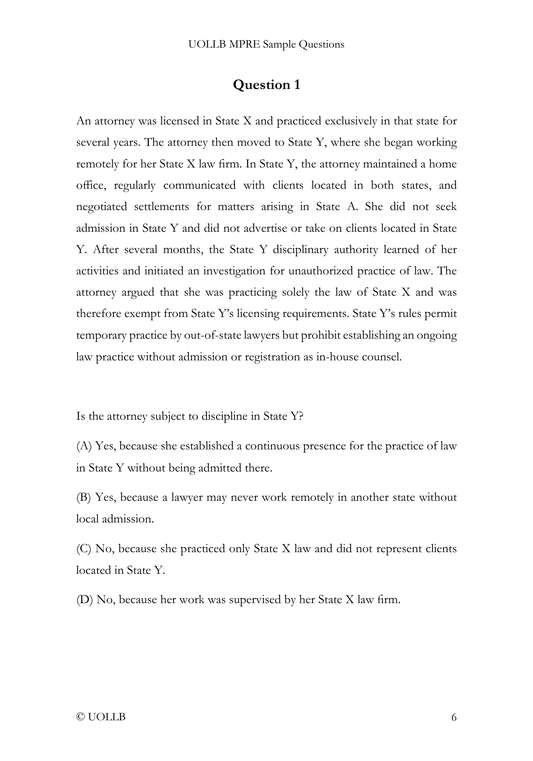
Rule 5.5: Unauthorized Practice of Law and Multijurisdictional Practice
A lawyer admitted in one state may not establish a permanent office in another state without being admitted there. However, a lawyer may temporarily practice in another state in connection with matters reasonably related to their home state practice, matters pending before a federal tribunal, or when associated with local counsel. A lawyer also may not assist nonlawyers in the unauthorized practice of law.
Rule 5.6: Restrictions on Right to Practice
A lawyer cannot enter into a partnership agreement, employment agreement, or settlement agreement that restricts their right to practice law after the relationship ends. Non-compete clauses in law firm agreements are prohibited because they interfere with clients' freedom to choose their counsel and restrict lawyer mobility. The only exception is agreements incident to the sale of a law practice.
Rule 5.7: Responsibilities Regarding Law-Related Services
When a lawyer provides services that are closely related to the practice of law but not themselves legal services, such as financial planning, lobbying, or title insurance, the rules of professional conduct still apply if the services are provided in connection with legal services or if the client is not clearly told the activity is not legal representation.
PUBLIC SERVICE
Rule 6.1: Voluntary Pro Bono Publico Service
Every lawyer has a professional responsibility to provide legal services to those who cannot afford them. The Model Rule sets an aspirational goal of at least 50 hours of pro bono service per year, with a substantial portion going to persons of limited means or organizations serving such persons. This is aspirational rather than mandatory under the Model Rules, though some states require annual reporting.
Rule 6.2: Accepting Appointments
A lawyer should not seek to avoid a court appointment to represent a person unless the representation would result in a conflict of interest, would be unreasonably financially burdensome, or the client or cause is so repugnant to the lawyer as to make effective representation impossible. Refusing appointments without good reason undermines the administration of justice.
Rule 6.3: Membership in Legal Services Organization
A lawyer may serve on the board of directors of a legal services organization even if that organization represents people whose interests may conflict with the lawyer's own clients, as long as the lawyer does not personally participate in any decision that adversely affects a client of the lawyer.
Rule 6.4: Law Reform Activities Affecting Client Interests
A lawyer may work on law reform efforts, such as lobbying for changes to statutes, even if those changes might benefit the lawyer's clients. The lawyer does not need to disclose which clients may benefit from the reform unless the benefit would be direct and particular to a specific client.
Rule 6.5: Nonprofit and Court Annexed Limited Legal Services Programs
When a lawyer provides short-term limited legal services, such as at a legal clinic or hotline, under the auspices of a nonprofit or court-annexed program, the conflicts of interest rules apply with less stringency. The lawyer is only disqualified if they actually know of a conflict at the time of the service. This accommodation helps expand access to legal help for people who cannot afford full representation.
INFORMATION ABOUT LEGAL SERVICES
Rule 7.1: Communications Concerning a Lawyer's Services
A lawyer must not make false or misleading communications about their services. A communication is misleading if it creates unjustified expectations, makes unfounded comparisons, or omits facts necessary to make the statement as a whole not materially misleading. This is the foundational rule for all lawyer advertising and marketing.
Rule 7.2: Communications Concerning a Lawyer's Services
A lawyer may advertise through any medium. However, a lawyer cannot give anything of value to a person for recommending the lawyer's services, with narrow exceptions such as paying the reasonable cost of advertising or participating in a nonprofit referral service. Any advertisement must include the name and contact information of at least one responsible lawyer or firm.
Rule 7.3: Solicitation of Clients
A lawyer cannot solicit professional employment through live in-person, telephone, or real-time electronic contact if the person has not asked for the communication and the primary motivation is pecuniary gain. This anti-solicitation rule protects vulnerable people from high-pressure sales tactics at their most vulnerable moments, such as after an accident or arrest. Written solicitations are generally permitted but must be labeled as advertising materials.
Rule 7.4: (Deleted)
This rule, which previously addressed communication of fields of practice and specialization, has been deleted from the Model Rules. The subject matter is now addressed within Rule 7.1.
Rule 7.5: (Deleted)
This rule, which previously addressed firm names and letterheads, has also been deleted. Its substance is now covered by Rule 7.1.
Rule 7.6: Political Contributions to Obtain Government Legal Engagements or Appointments
A lawyer or law firm cannot make political contributions for the purpose of obtaining government legal work or a judicial appointment. This "pay-to-play" prohibition is designed to prevent corruption and ensure that government legal engagements are awarded on merit, not as a reward for political fundraising.
MAINTAINING THE INTEGRITY OF THE PROFESSION
Rule 8.1: Bar Admission and Disciplinary Matters
A lawyer must not knowingly make a false statement of material fact in connection with a bar admission application or a disciplinary proceeding. A lawyer also must not fail to disclose facts necessary to correct a misapprehension and must not interfere with an investigation by failing to respond. Honesty in dealings with disciplinary authorities is non-negotiable.
Rule 8.2: Judicial and Legal Officials
A lawyer must not make false statements about the qualifications or integrity of a judge, adjudicatory officer, or candidate for judicial office if the lawyer knows the statement is false or makes it with reckless disregard for its truth. Honest and good-faith criticism of judges is protected, but knowingly false attacks on judicial integrity are not.
Rule 8.3: Reporting Professional Misconduct
A lawyer who knows that another lawyer has committed a violation that raises a substantial question about that lawyer's honesty, trustworthiness, or fitness must report it to the appropriate disciplinary authority. Similarly, a lawyer who knows of judicial misconduct that raises substantial fitness questions should report it. The duty to report does not apply when the information is protected by the confidentiality rule.
Rule 8.4: Misconduct
This rule defines professional misconduct broadly. It is a violation for a lawyer to violate the rules, attempt to violate them, or assist others in doing so. It is also misconduct to commit a criminal act that reflects adversely on the lawyer's honesty, trustworthiness, or fitness as a lawyer, or to knowingly assist a judge or judicial officer in conduct that is a violation of applicable rules. Engaging in conduct involving dishonesty, fraud, deceit, or misrepresentation is also prohibited, as is conduct that constitutes harassment or discrimination on the basis of protected characteristics.
Rule 8.5: Disciplinary Authority and Choice of Law
A lawyer admitted in a state is subject to that state's disciplinary authority, even for conduct occurring outside the state. When conduct is connected to more than one jurisdiction, the rules of the jurisdiction where the conduct occurred generally apply, or the rules of the jurisdiction where the court proceeding is pending. This rule resolves choice-of-law questions when a lawyer's conduct touches multiple jurisdictions.
KEY TAKEAWAYS FOR THE MPRE
The Model Rules use precise language to signal the strength of each obligation. "Shall" imposes a mandatory duty; violation can lead to discipline. "Should" is aspirational. "May" signals permissive discretion. Some straightforward rules, such as the Rule 2.1 requirement to render candid advice, are adopted without modification by the vast majority of jurisdictions, while other more detailed rules are the subject of extensive modifications in nearly all states. For exam purposes, always apply the Model Rules as written unless the question specifies a different jurisdiction's rule. The Comments to the Rules are not binding but are important interpretive tools that frequently appear in MPRE questions as context for understanding what a rule requires.