NextGen UBE Question Types
Share
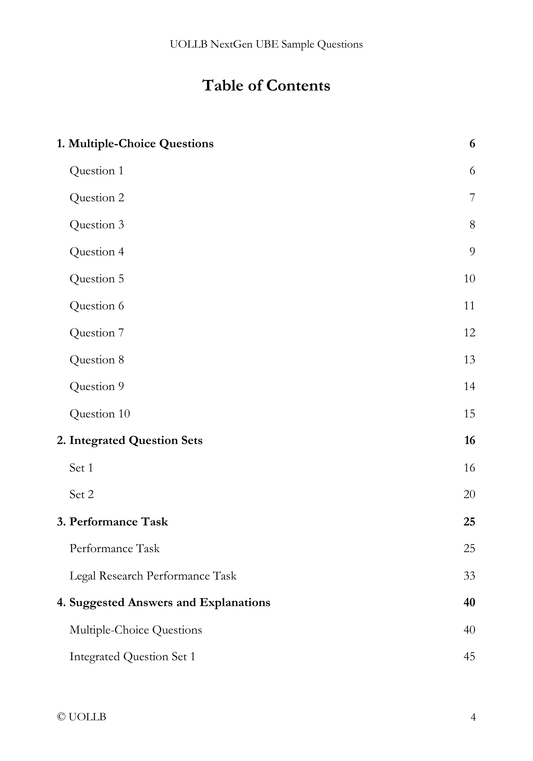
The NextGen UBE uses three distinct types of questions, each designed to assess both legal knowledge and the practical skills expected of a new attorney. These question types appear throughout the exam in a consistent order within each three-hour section, blending short, precise tasks with longer, practice-oriented assignments.
Multiple-Choice Questions (Estimated Time: 72 minutes)
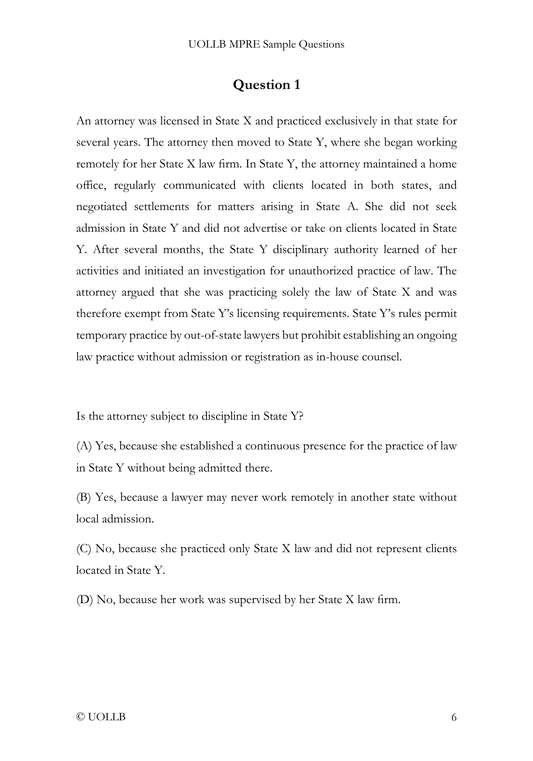
The first category consists of standalone multiple-choice questions. These questions appear in two formats. Some require you to select one correct answer out of four options, while others ask you to select two correct answers out of six. Across the entire exam, there are 40 standalone multiple-choice questions per section, for a total of 120 for three sections. The questions focus on the Foundational Concepts and Principles and present these concepts and principles in roughly equal numbers, although individual questions may draw on more than one concept at a time. Each question is completely independent. No question relies on information from another, so each can be answered on its own terms. You typically spend about 1.8 minutes on each question. Partial credit is available for the select-two format, and these standalone multiple-choice questions account for 49 percent of the total exam score.
Integrated Question Sets (Estimated Time: 48 Minutes)
The second category is composed of integrated question sets. Each set is built around a shared factual scenario, and there are two such sets in each section, making six sets in total for three sections. These sets appear in two formats. Drafting sets require medium-length written responses, while counseling sets mix multiple-choice and short-answer questions. You are tested on how well you can use the Foundational Skills in realistic situations that mirror the work expected of a beginning lawyer. Although the focus of the exam is on the Foundational Concepts and Principles, integrated question sets may incorporate additional areas of doctrinal law not included in the foundational list. When this occurs, the necessary legal resources will be provided within the set. These sets may draw on more than one doctrinal area at once and do not distribute doctrinal content evenly. The legal resources provided may include statutes, judicial opinions, police reports, deposition excerpts, or other documents. You usually spend about 24 minutes on each set, and partial credit is available for both short-answer and medium-answer questions as well as select-two multiple-choice items. Integrated question sets make up 21 percent of the total exam score.
Performance Tasks (Estimated Time: 60 Minutes)
The third category consists of one performance task, which appears in each section for a total of three tasks. This task requires you to complete assignments resembling those given to new associates in law offices. The performance task comes in two formats. The standard performance task is a single, longer writing assignment. The legal research performance task begins with several multiple-choice and short-answer questions that lead into a medium-length written response. Both of them may require skills or knowledge that go beyond the Foundational Concepts and Principles. In such cases, the question will always include all the necessary resources you need to complete the task. For instance, if a task involves research and writing using state Trusts and Estates law, all the relevant legal rules will be provided. Each task includes a case file and a library of legal materials, allowing you to analyze facts, interpret legal authorities, and produce a structured, clear work product. You generally spend about one hour on each task. Partial credit is available for short-, medium-, and longer-answer responses, as well as select-two multiple-choice questions. The performance tasks constitute 30 percent of the overall exam score.
Pretest Questions
In addition to the scored items, the exam includes pretest questions. Out of the 120 standalone multiple-choice questions, 20 are pretest items, and one of the six integrated question sets is also designated as a pretest set. These items are used to evaluate the quality and effectiveness of future exam questions. They do not affect the your score and are intentionally indistinguishable from scored questions. The performance tasks are pretested separately and do not appear as pretest items within the live exam.