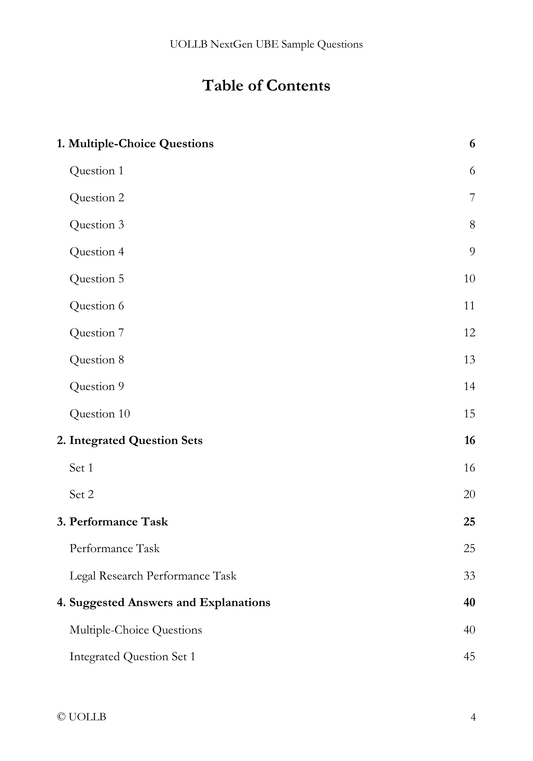
NextGen UBE Foundational Skills and Tasks
Share
The NextGen UBE represents a deliberate shift from memorisation-heavy testing toward an assessment model grounded in practical lawyering competence. This new bar exam framework evaluates candidates not only on doctrinal knowledge but on how effectively they apply that knowledge in realistic legal contexts. Central to this redesign is the concept of Foundational Skills, which are assessed in conjunction with Foundational Concepts and Principles and other areas of substantive law.
The Foundational Skills are organised into four distinct groups. Each group reflects a core dimension of entry-level legal practice, and each is measured through defined tasks embedded within integrated exam question sets. While a single task may involve multiple skills across different groups, each task is aligned primarily with one skills group, ensuring that the exam systematically measures minimum competence across all dimensions of modern lawyering.
Foundational Skills Group A
This group focuses on Issue Spotting and Analysis, as well as Investigation and Evaluation. The purpose of this group is to assess whether an examinee can apply fundamental legal principles and sound legal reasoning to a given fact pattern. Rather than testing isolated rule recall, the exam requires candidates to identify legally significant facts, determine which issues are triggered, evaluate competing arguments, and reach reasoned conclusions. This mirrors the analytical process that lawyers undertake when advising clients, assessing liability, or preparing litigation strategy. It reflects the intellectual core of legal practice: structured reasoning grounded in law.
Foundational Skills Group B
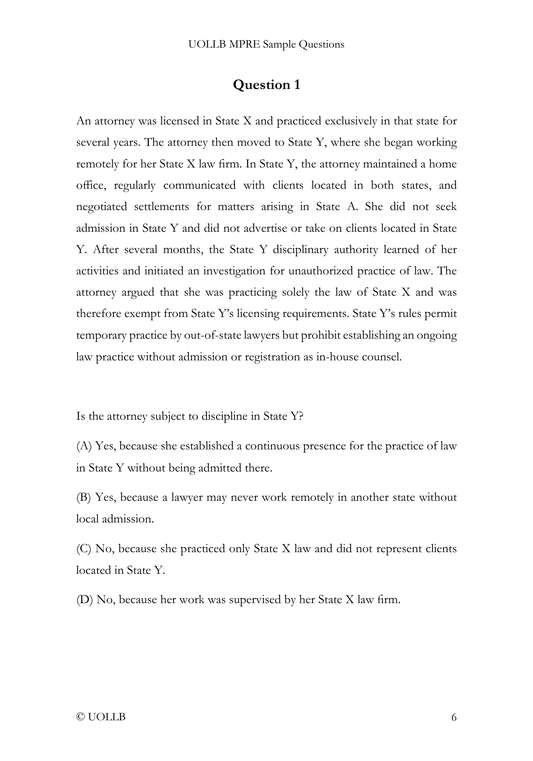
This group focuses on Client Counseling and Advising, Negotiation and Dispute Resolution, and Client Relationship and Management. It evaluates whether examinees can identify appropriate lawyering strategies within the lawyer-client relationship, consistent with relevant professional rules and with the client’s objectives, interests, and constraints. The emphasis is not merely on knowing the law, but on understanding how to use it strategically and ethically. Candidates may be required to recommend courses of action, evaluate settlement options, or identify potential conflicts of interest. This group recognises that effective lawyering involves judgment, communication, and professional responsibility in addition to technical knowledge.
Foundational Skills Group C
This group concerns Legal Research. Its purpose is to assess whether examinees can identify and implement appropriate research strategies. This includes preliminary issue-spotting, working effectively with provided authorities, developing and refining a theory of the case, and reaching closure on research questions. The NextGen UBE does not expect rote memorisation of obscure rules; instead, it evaluates the candidate’s ability to locate, interpret, and apply legal authorities in a structured and efficient manner. This reflects the reality that modern legal practice depends heavily on competent research and the ability to synthesise legal sources.
Foundational Skills Group D
This group concerns Legal Writing and Drafting. The purpose of this group is to assess whether examinees can complete a legal writing or drafting task in accordance with relevant legal standards and in a manner consistent with the client’s objectives, interests, and constraints. Tasks may require drafting memoranda, correspondence, or other practice-oriented documents. Clarity, organisation, accuracy, and audience awareness are central. This component recognises that the ability to communicate legal analysis effectively is a defining feature of professional competence.
The NextGen UBE is designed not as a collection of isolated doctrinal questions, but as an integrated assessment of whether you can function as a minimally competent entry-level attorney. Knowledge remains essential, but it is measured through application, judgment, and communication rather than abstract recall. If you are preparing for the NextGen UBE, it is important to understand that preparation must now extend beyond memorising black-letter law to developing the analytical, strategic, research, and writing abilities that define professional practice.