Application of Legal Principles and Rules in SQE1
Share
SQE1 does not merely test whether you can memorise legal rules. Instead, it focuses heavily on the application of legal principles and rules to realistic client-based scenarios. You are expected to think and respond like a practising solicitor by identifying the relevant law, applying it accurately to the facts, and reaching a legally justified conclusion.
1. Identify and apply a legal principle or rule
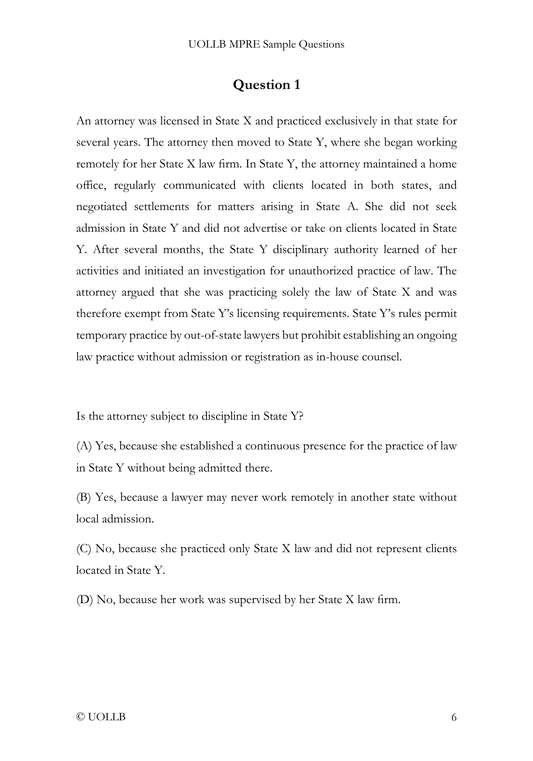
One style of SQE1 question requires you to both identify and apply a legal principle or rule. In these questions, the relevant area of law is not stated directly. You must first recognise which legal principle governs the situation and then apply it to the facts provided. For example, a question may describe a dispute over a will and require the candidate to identify the rules concerning testamentary capacity before deciding whether the will is valid. Success therefore depends not only on legal knowledge but also on accurate issue spotting and factual analysis.
2. Apply the legal principle or rule to determine the legal outcome
Another type of question identifies the relevant legal principle or rule but tests whether you can apply it correctly and determine the legal outcome. In this style of question, the law itself may already be provided or obvious, but the challenge lies in understanding how the rule operates in practice. For example, the question may state the legal requirements for adverse possession and then ask whether the claimant acquires title based on the facts. Here, the question assesses your ability to interpret facts carefully and distinguish between legally significant and insignificant information.
3. Advise clients realistically and professionally
SQE1 also tests whether you can advise clients realistically and professionally. You may be asked whether a client can legally achieve a desired objective and what advice should properly be given. This reflects the practical role of solicitors, who must often explain limitations in the law to clients. For example, a client may wish to challenge a will, avoid inheritance tax, or remove a trustee. You must assess whether the law permits the desired outcome and identify any procedural or legal barriers. You are expected not only to know the law but also to explain its practical consequences clearly and accurately.
4. Explain why the law produces a specific result
In some questions, the legal outcome is already stated within the scenario, and you must explain why the law produces that result. These questions test deeper legal understanding rather than simple recall. The candidate may need to identify the precise rule, doctrine, or statutory provision that justifies the outcome. For example, the question may state that a beneficiary cannot inherit under a will and ask the candidate to identify the legal principle responsible for that result, such as forfeiture or lapse. This requires candidates to understand the reasoning behind legal outcomes rather than merely memorising conclusions.