Correct and Comprehensive Application of Law in SQE2
Share
Correct and comprehensive application of law is a core assessment criterion in the SQE2 assessment. It assesses your ability not only to know the law, but also to apply it accurately, thoroughly, and professionally to realistic client situations. The assessment focuses on three connected elements: whether your application of the law is legally correct, legally comprehensive, and consistent with ethics and professional conduct obligations. The standard expected is informed by the Solicitors Regulation Authority Statement of Solicitor Competence and the SQE2 Functioning Legal Knowledge requirements.
The aspect of legal correctness concerns the accuracy of your legal analysis. You must identify the relevant legal principles, rules, procedures, or authorities and apply them properly to the facts presented in the assessment. The focus is on whether you reach conclusions that are legally sound and supported by the applicable law. For example, in a client interview, advocacy exercise, or legal writing task, you would gain credit for identifying the correct legal test, explaining the relevant procedural requirements, and applying those rules accurately to the client’s circumstances. If you apply the wrong legal principle, misunderstands the law, or reaches an incorrect conclusion, marks may be lost even if the communication is otherwise strong.
The aspect of legal comprehensiveness examines the depth and completeness of the legal analysis. It is not enough merely to identify one relevant rule; you are expected to consider all significant legal issues arising from the facts and analyse them in sufficient detail. A comprehensive answer demonstrates awareness of the wider legal context, alternative arguments, procedural implications, exceptions, risks, and practical consequences for the client. Credit is therefore awarded not only for spotting the main issue, but also for recognising connected issues and providing a balanced and complete analysis. Strong SQE2 performance usually involves structured reasoning that explains how multiple legal principles interact in the factual scenario.
The distinction between these two aspects can be illustrated through different assessment types. Where the question requires you to identify the relevant law independently, legally correct marks may be awarded for identifying the appropriate legal principles and applying them accurately to the facts. Legally comprehensive marks may then be awarded for identifying additional relevant issues, discussing nuances or exceptions, and fully analysing the implications of the law for the client’s situation. By contrast, where the legal principles are already provided within the question, the legally correct element may focus mainly on applying those principles accurately, while the legally comprehensive element focuses on the thoroughness and sophistication of the analysis.
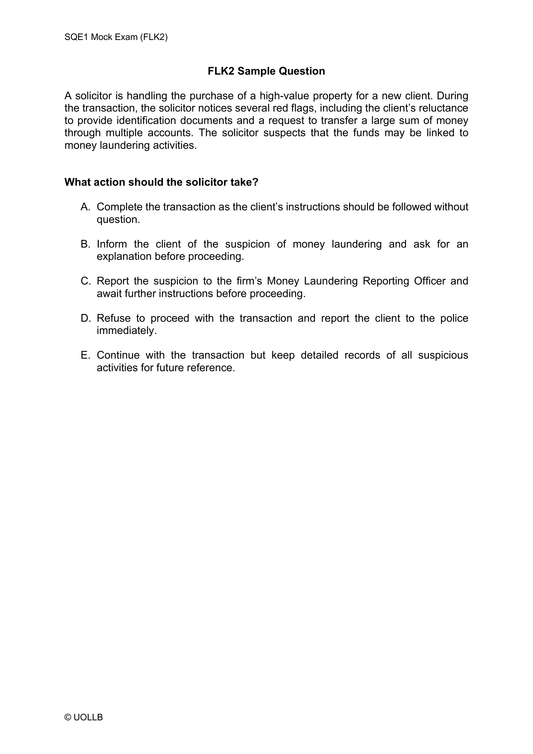
Ethics and professional conduct form an essential part of the application of law assessment. You are expected to identify ethical issues whenever they arise and resolve them in accordance with professional obligations. This includes acting honestly, maintaining integrity, protecting client confidentiality, avoiding conflicts of interest, and complying with the Solicitors Regulation Authority