How to Study Solicitors Accounts for SQE1
Share
It is perfectly understandable why many law students are afraid of numbers. Solicitors Accounts is one of those subjects that divides SQE1 candidates sharply. Some find it satisfying, rule-based, logical, and therefore more predictable than areas like land law or contract. Others find the accounting terminology alienating and the rules hard to visualise without a practical context. Whichever camp you fall into, the good news is that Solicitors Accounts is a subject where the right study method makes an enormous difference. This guide shows you how to approach it efficiently and effectively.
Understand what you are actually being tested on
Before you open a textbook, it helps to know what the SQE1 exam is and is not asking you to do. The SQE1 is not an accountancy exam. You will not be asked to prepare a set of accounts, balance a ledger from scratch, or demonstrate bookkeeping technique. What the exam tests is your understanding of the SRA Accounts Rules, specifically whether you can apply those rules to a practical scenario and identify what a solicitor is required to do.
This distinction matters because it tells you where to focus your energy. You need to understand rules and their application. You do not need to master the mechanics of double-entry bookkeeping. Many candidates waste time on detailed ledger work that the exam does not reward.
Common mistake
Spending hours practising debit and credit entries in full ledger format. SQE1 questions are multiple-choice questions that ask what the rule requires, not what the ledger looks like. Redirect that time to scenario-based practice questions instead.
Start with the SRA Accounts Rules directly
The SRA Accounts Rules are short. There are just 13 rules written in relatively plain English compared to many pieces of legal regulation. Reading the actual rules, not just a textbook summary of them, gives you two advantages. First, you encounter the precise language that exam questions are built around. Second, you see how the rules are structured, which makes it easier to locate the answer to a scenario question by reasoning from principle rather than memorisation.
The rules are available free on the SRA website. Read them once through before you begin any course material. You will not understand everything on first reading, but you will have a mental map of the territory that makes everything you study afterwards easier to place.
Study the 9 topic areas in order
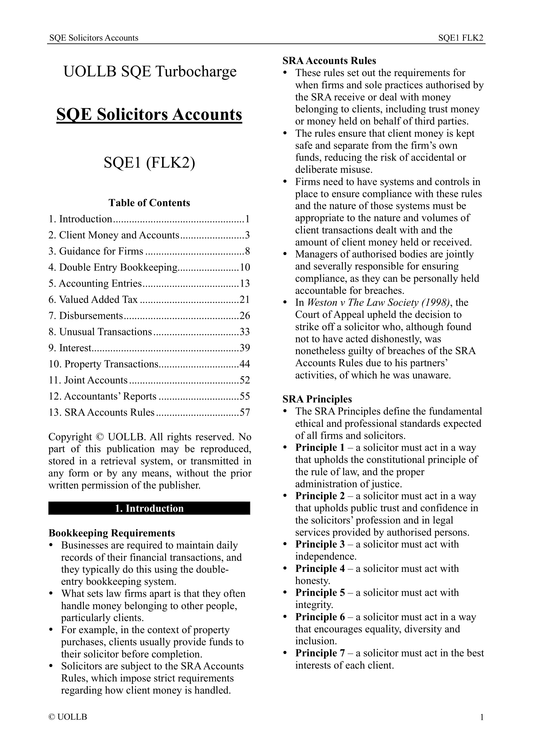
The SQE1 specification organises Solicitors Accounts into 9 distinct topic areas. Study them in the order the specification presents them, because they build on each other. Understanding client money comes before understanding client account, which comes before understanding withdrawals, and so on. Jumping between topics without that foundation makes each one harder than it needs to be.
1. Client money: definition, when it must go into client account, when it may be withheld, repayment
2. Client account: definition, name, prohibition on using it as banking facilities, withdrawals
3. Requirement to keep client money separate from the authorised body's own money
4. Interest on client money: when the obligation to pay arises, how it is calculated
5. Breach of the SRA Accounts Rules: duty to correct promptly on discovery
6. Accurate records and reconciliation: ledgers, bills, disbursements, VAT, transfers, mixed payments
7. Joint accounts and operation of a client's own account
8. Third-party managed accounts
9. Accountants' reports: obtaining, delivering, storing and retaining accounting records
Topics 1 to 5 carry the highest exam weight and should receive the most study time. Topics 7 to 9 are more straightforward and require less depth, though you should not ignore them entirely.
Master the core principle first
Everything in Solicitors Accounts flows from one foundational idea: client money belongs to the client, not the firm, and must be protected accordingly. Every rule in the SRA Accounts Rules is an expression of that principle in one form or another. If you internalise that idea before studying the individual rules, the rules begin to feel logical rather than arbitrary. Logical rules are far easier to apply under exam pressure than a list of memorised obligations.
Anchor question
Whenever you face a Solicitors Accounts question, ask yourself first: whose money is this, and what does that mean for how it must be handled? That single question will orient you correctly for the vast majority of scenarios.
A step-by-step study approach
1. Read the SRA Accounts Rules in full once
Do this before any other material. Thirty minutes is enough. You are building a mental map, not memorising rules yet.
2. Study each topic area with a structured note
For each of the 9 topics, write a one-page summary: what the rule requires, when it applies, and what the consequences of breach are. Keep it concise. The goal is clarity, not comprehensiveness.
3. Do practice questions after each topic, not at the end
Solicitors Accounts is a subject where active recall matters more than passive reading. After studying each topic, do five to ten scenario-based questions on that topic before moving on. This embeds the rules far more effectively than reading alone.
4. Review your errors carefully
When you get a practice question wrong, do not just note the correct answer and move on. Identify which rule you misapplied or misunderstood, go back to that rule in the SRA Accounts Rules, and re-read it in context. Errors in accounts questions are almost always rule misapplication rather than careless mistakes.
5. Do a full mixed-topic practice set in the final week
Once you have studied all 9 topics, do a set of mixed accounts questions in exam conditions, i.e. timed, no notes. This simulates the experience of switching between accounts topics mid-paper and ensures you have not siloed your knowledge by topic.
How much time to allocate
Solicitors Accounts does not require the same time investment as the larger FLK2 subjects such as Property Practice or Wills and Administration of Estates. A focused study plan of 8 to 12 hours spread across the 9 topic areas is sufficient for most candidates to reach a competitive level. If you are starting from no prior knowledge of the SRA Accounts Rules, allow closer to twelve hours. If you have some professional experience with client accounts, eight hours may be enough.
The key is to distribute that time across reading, note-making, and most importantly, practice questions. A rough allocation that works well is one third reading and notes, two thirds practice questions and error review. Most candidates who struggle with accounts have done the inverse: extensive notes, very little practice.
The topics that reward the most study time
Not all topics are equally likely to appear or equally complex. Prioritise in this order:
1. Client money: the most fundamental topic and the one most questions ultimately relate back to. Get this absolutely right.
2. Client account, withdrawals, and residual balances: consistently high-frequency in exam sittings. The prohibition on improper withdrawals and the rules on transfers between office and client account appear regularly.
3. Breach and correction: the SRA takes breaches of the accounts rules seriously, and so does the exam. Know what a breach looks like and what the solicitor must do immediately on discovering one.
4. Records, bills, and disbursements: this topic is broad but the exam tends to focus on the VAT treatment of disbursements and the correct handling of mixed payments covering fees and disbursements together.
5. Interest on client money: the obligation to pay a fair sum of interest is often tested in scenario form. Know when the obligation arises and when it does not.
Topics 7 to 9, namely joint accounts, third-party managed accounts, and accountants' reports, are worth covering but are less frequently tested in depth. A single focused session on each is sufficient.
Putting it all together
Solicitors Accounts rewards a methodical approach. The subject has a logic to it. Once you understand that every rule exists to protect client money. That logic makes even unfamiliar scenarios manageable if you reason from principle. The candidates who struggle are usually those who try to memorise rules in isolation without understanding why they exist, or who skip the practice questions that cement understanding into exam-ready recall.
The study plan in brief
Read the SRA Accounts Rules once. Study the 9 topics in order with concise notes. Do practice questions after every topic, not just at the end. Budget 8 to 12 hours in total, weighted two-thirds towards practice and error review. Prioritise client money, client account, disbursements, mixed payments, interest on client money, VAT, withdrawals, and breach above all else.