What UK Lawyers Need to Know About Qualifying as an American Attorney in the New York State
Share
Lawyers qualified in England and Wales looking to qualify in the United States often assume that the shared common law tradition between the two countries will smooth their path to admission. In many cases it does, but the process is more complex than it might first appear, and the differences between UK legal qualifications matter enormously. Before anything else, the fundamental rule applies equally to everyone: all foreign lawyers, regardless of experience or seniority, must pass the bar exam in whichever US state they wish to practise. The question is not whether you must sit the exam, but whether you are eligible to do so.
Why New York?
The United States is a country of multiple jurisdictions, each with its own rules governing the admission of foreign lawyers, and choosing the right state is itself a strategic decision. New York, given the scale and global reach of its legal market, is by far the most popular destination for overseas lawyers seeking US qualification, and it serves as a useful model for understanding the requalification process more broadly.
The Importance of Your UK Qualification
The United Kingdom is itself a country of more than one legal jurisdiction, and where you obtained your legal education will directly affect your eligibility. England and Wales is a common law jurisdiction, and qualifications from it are generally well-regarded by US bar authorities. Scotland, however, is not a purely common law jurisdiction, and a standard Scottish law degree is unlikely to be recognised by the New York State Board of Law Examiners as substantively equivalent to an ABA-approved JD. Unless a Scottish degree is specifically structured as a common law qualification, the graduate will typically need to spend a further year completing an LLM at an ABA-approved law school to cure that substantive deficiency before becoming eligible to sit the bar exam.
For graduates of English and Welsh law schools, the picture is generally more straightforward, provided the degree was the right kind and was completed in the right way. The New York State Board of Law Examiners requires foreign academic qualifications to be both substantively and durationally equivalent to an ABA-approved JD. A full-time, on-campus, three-year common law LLB satisfies both requirements, and its holder can apply to sit the New York Bar Exam (Uniform Bar Exam) directly on the strength of that qualification alone.
The GDL Route and Its Limitations
However, problems arise for those who enters the legal profession via the Graduate Diploma in Law (GDL), which is a one-year conversion course taken by non-law graduates. A GDL is not considered durationally equivalent to a three-year JD, and this deficiency cannot simply be resolved by obtaining another legal qualification. Completing the GDL alongside a one-year Legal Practice Course or Bar Training Course does not resolve the issue, as the combined qualifications are still not regarded as durationally equivalent to an ABA-approved JD. However, if you also complete a common law LLM in the UK or an LLM in an ABA-approved American law school full-time on campus, you will be able to cure the durational gap in your legal qualifications.
The SQE, CILEX and Distance Learning Routes
Those who have qualified via the SQE or through CILEX, without an underlying academic qualification that is substantively or durationally equivalent to an ABA-approved JD, face a harder constraint. The ABA-approved LLM route is only available to cure a deficiency in one dimension, either substance or duration, but not both simultaneously. Where the academic foundation is deficient on both counts, no amount of postgraduate study in an ABA-approved law school can bridge that gap under the New York rules. The same limitation applies to degrees obtained through online or distance learning programmes, whether from British institutions or elsewhere. Lawyers who qualified by these routes will find themselves ineligible to sit the New York Bar Exam regardless of how many years they have practised.
Passing the Exam Is Not the Finish Line
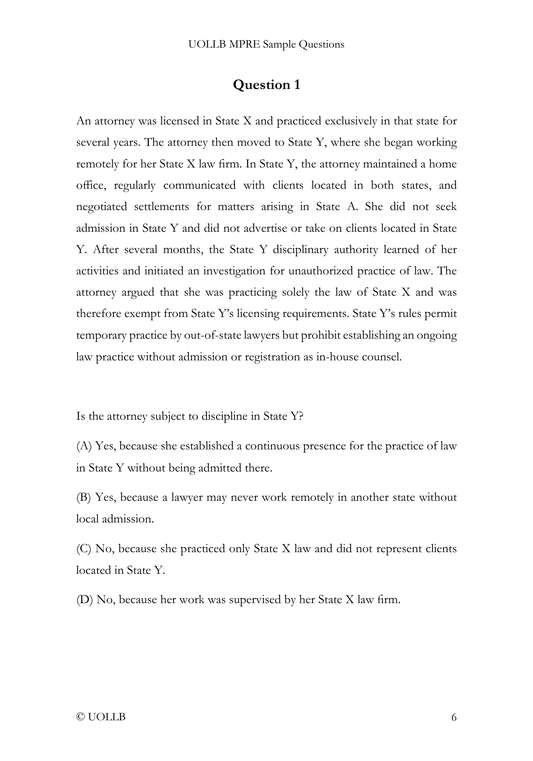
For those who do become eligible and go on to pass the bar exam, it is important to understand that admission does not follow automatically. New York imposes a number of additional requirements beyond the bar exam itself. You must also complete the New York Law Course, pass both the New York Law Exam and the Multistate Professional Responsibility Exam (MPRE), and earn 50 hours of pro bono credit before you can be formally admitted as a New York attorney. These requirements are not especially onerous, but they must be planned for, and therefore you should not assume that a passing bar exam score is the last step in the process.
Planning Ahead
The overarching message for any UK lawyer considering this route is to assess their specific qualifications carefully and early. The differences between a three-year LLB, a GDL, a distance-learning degree, and a Scottish qualification can be the difference between a relatively direct path to US admission and a significantly longer and more expensive one, or in some cases, no viable path at all. Planning ahead and filing for an eligibility evaluation with the New York State Board of Law Examiners well in advance of any intended bar exam sitting is always the prudent first step.