Solicitors Qualifying Exam (SQE) vs Chartered Institute of Legal Executive (CILEX)
Share
The English and Welsh legal profession has never offered more ways in. For decades, becoming a solicitor meant one track: a law degree, a Legal Practice Course (LPC), and a training contract. CILEX existed as an alternative, but it was less understood and frequently undervalued. Today, legal training looks very different. The Solicitors Qualifying Examination has replaced the LPC, CILEX has overhauled its own qualification framework with the CILEX Professional Qualification, and a generation of aspiring lawyers is weighing up which route makes more sense for them. This article walks you through both qualifications in depth.
What Is the SQE?
The Solicitors Qualifying Examination (SQE), is the centralised assessment introduced by the Solicitors Regulation Authority (SRA) in September 2021. It replaced the LPC and is now the standard pathway for anyone who wants to qualify as a solicitor in England and Wales.
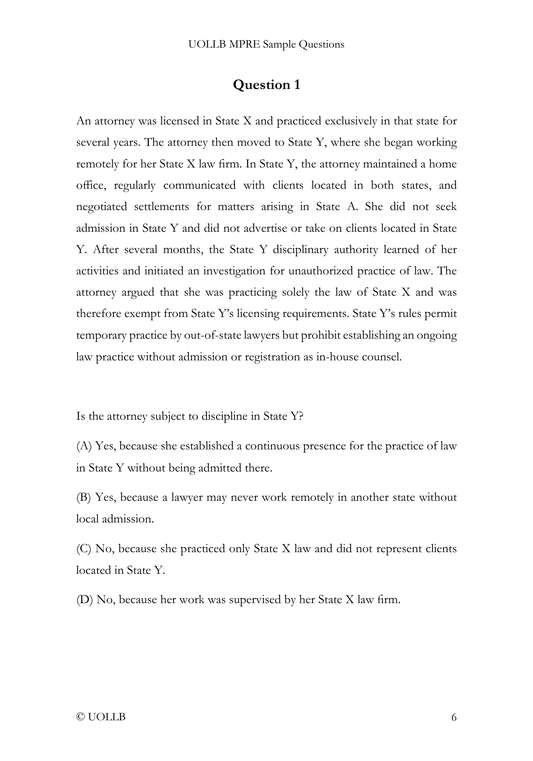
The SQE is divided into two stages. SQE1 assesses functioning legal knowledge across a broad range of legal areas, such as contract law, torts, criminal law, property law, equity and trusts, constitutional and administrative law, EU law, business law, wills and estate administration, solicitors accounts, and ethics and professional conduct, through 360 multiple-choice questions split across two sittings known as FLK1 and FLK2. The questions are designed to test application of the law to practical scenarios rather than pure recitation of doctrine. SQE2 then tests practical legal skills through a series of oral and written assessments, including client interviewing, case and matter analysis, legal research, legal writing, legal drafting, and advocacy. You must demonstrate these skills across both contentious (litigation) and non-contentious (transactional) contexts.
To complete qualification, you must also undertake two years of Qualifying Work Experience (QWE). This can be accumulated across up to four different legal employers and does not need to follow a prescribed structure. A wide range of roles qualify, from traditional training contracts at large firms to in-house positions, paralegal work, and roles at law clinics. Employers who provide QWE must be able to confirm that the candidate has developed and demonstrated some or all of the SRA's prescribed professional skills during the placement.
One of the most discussed features of the SQE is that it imposes no prescribed preparatory course. You can prepare however you choose, whether through a university law degree, a graduate diploma in law, a dedicated SQE preparation course, self-study, or a combination of these. However, the SRA does require you to hold a degree (in any subject) or an equivalent Level 6 qualification before sitting SQE1. This degree requirement is not trivial, and it considerably shapes the overall cost and timeline of the route.
What Is CILEX?
CILEX stands for the Chartered Institute of Legal Executives. It is the professional body that regulates and represents Chartered Legal Executives in England and Wales, and it offers a qualification route that leads to a completely different but equally recognised professional title: CILEX Lawyer, also known as a Chartered Legal Executive.
The qualification framework CILEX uses is the CILEX Professional Qualification (CPQ), which was overhauled and relaunched to create a more structured and flexible progression pathway. The CPQ is divided into three stages. The Foundation stage, studied at Level 3 and broadly equivalent to A-level standard, leads to the title of CILEX Paralegal. The Advanced stage, at Level 6, leads to the title of CILEX Advanced Paralegal. The Professional stage, also at Level 6 but more advanced in scope, leads to the full title of CILEX Lawyer upon completion of the required qualifying employment. Candidates who already hold a qualifying law degree or Graduate Diploma in Law can access the framework at an advanced stage, significantly shortening the journey.
Throughout the CPQ, you study specific legal practice areas rather than the entire spectrum of law. A candidate who wants to qualify in conveyancing, for example, will study residential property law and practice in depth rather than sitting broad assessments across all areas of law. This specialist focus is one of the defining characteristics of the CILEX route, and it shapes both the experience of studying and the type of lawyer a CILEX qualification produces.
The CPQ is explicitly designed to be completed while working. You are expected to be in paid legal employment, and the assessments are built around the idea that study and professional practice reinforce each other. This work-integrated model is not just a convenience but is central to the CILEX philosophy that the best lawyers are trained in the office as much as in the classroom.
In addition to completing the assessed units of the CPQ, you must accumulate 2,300 hours of qualifying legal employment across their training period and maintain a portfolio demonstrating that they have applied their legal knowledge in a work context. Once those requirements are satisfied and the Fellowship application is approved, you become a fully qualified CILEX Lawyer.
The Qualification Each Route Produces
Before comparing the two in detail, it is worth being precise about what you actually become at the end of each path.
Passing the SQE, completing two years of QWE, and satisfying the SRA's character and suitability requirements results in admission to the roll of solicitors. You become a solicitor of England and Wales, which is a title that carries broad rights of practice across virtually all areas of civil and criminal law, is recognised internationally, and is what most law firms mean when they advertise positions for qualified lawyers.
Completing the CPQ, satisfying the employment requirements, and being accepted into Fellowship results in qualification as a CILEX Lawyer, formally known as a Fellow of CILEx. A CILEX Lawyer has full and independent practice rights, but those rights are authorised within specific legal practice areas corresponding to the areas studied during training. A CILEX Lawyer qualified in family law can conduct litigation, advise clients independently, and in due course apply for rights of audience. That same lawyer does not automatically hold the same rights in a practice area they have not qualified in.
This is not as limiting as it sounds. Most legal work is concentrated in a relatively small number of high-volume practice areas, including conveyancing, family, wills and probate, employment, and personal injury. A CILEX Lawyer specialising in any of those areas can build a full and independent legal career. But if your ambitions involve regularly moving across practice areas, taking on complex multi-disciplinary work, or practising in areas such as international arbitration or mergers and acquisitions, the broader practice rights of the solicitor title are likely to be more useful.
1. Core Comparison and Career Outcome
| SQE | CPQ | |
|---|---|---|
| Final Title | Solicitor | CILEX Lawyer (Chartered Legal Executive / Fellow of CILEx) |
| Regulator | Solicitors Regulation Authority (SRA) | Chartered Institute of Legal Executives (CILEX) |
| Scope of Practice Rights | Full practice rights across all areas of law upon admission | Full independent practice rights within authorised specialist areas |
| Approach to Legal Knowledge | Generalist: broad legal knowledge tested across all core areas; specialisation follows qualification | Specialist: in-depth training in chosen practice areas from an early stage |
| Rights of Audience | Full higher rights of audience available upon application | Higher Rights of Audience available for eligible CILEX Lawyers |
| Partnership and Firm Ownership | Can become a partner in any law firm; can own a law firm | Can become a partner; eligible CILEX Lawyers can own and operate authorised legal practices |
| Judicial Appointments | Eligible for judicial appointments | Eligible for judicial appointments |
| Market Recognition | Widely and immediately recognised across private practice, in-house, public sector, and international markets | Highly respected within the legal profession, particularly in specialist practice areas; growing recognition among the public |
The gap in market recognition deserves a nuanced discussion. Historically, the CILEX title was treated as second-tier within the profession, and it would be dishonest to pretend that stigma has entirely disappeared everywhere. Some employers, particularly large commercial firms competing for international work, still tend to recruit solicitors by default, and some clients associate legal advice with the solicitor title specifically. In the modern legal market, however, and especially in regional practice, specialist fields, and high-volume areas, the CILEX Lawyer title is taken seriously by employers and clients alike. CILEX Lawyers hold the same statutory status as solicitors within their authorised practice areas under the Legal Services Act 2007, and that legal equivalence matters.
The entry requirements reveal one of the most significant differences in access between the two routes. The SQE, despite being presented as a flexible and accessible reform, still requires a degree. For someone who left school at eighteen and went straight into a legal office job, the SQE is not an immediate option as they would first need to obtain a degree, most likely while continuing to work. CILEX, by contrast, allows that same person to begin studying towards a professional legal qualification immediately, earning a recognised legal title at the paralegal stage before progressing to full qualification. This genuine accessibility has been one of the strongest arguments for the CILEX route since its inception, and it remains a compelling one.
2. Entry Requirements and Structure
| SQE | CPQ | |
|---|---|---|
| Minimum Entry Requirement | A degree (in any subject) or a Level 6 equivalent qualification. There is no academic entry requirement below degree level | Open entry at Foundation level. No prior qualifications are required to begin |
| Route for School Leavers | Not directly accessible without first completing a degree or equivalent | Accessible immediately after school, progressing through Level 3 and Level 6 stages |
| Route for Law Graduates | Law degree satisfies academic requirement; candidate proceeds to SQE preparation and sits SQE1 and SQE2 | Eligible for exemptions at Foundation and Advanced stages; can enter directly at the Professional stage in many cases |
| Route for Non-Law Graduates | Must complete a Graduate Diploma in Law (GDL) or equivalent conversion course before sitting the SQE, or prepare for SQE without a law degree | Eligible for exemptions based on degree; exemption assessment varies by prior qualification |
| Route for Career Changers | Flexible preparation model accommodates those coming from other professions, but degree requirement still applies | Explicitly designed for career changers already working in a legal environment |
| Exemptions | Limited exemptions for domestic candidates; SRA offers some exemptions for foreign lawyers and those with equivalent foreign qualifications | Extensive exemption framework for holders of recognised prior qualifications including LLB, GDL, and LPC |
| Assessment Format | Two centralised, standardised assessments set and marked by an independent assessment organisation (Kaplan): SQE1 (multiple choice) and SQE2 (oral and written practical exercises) | Modular written assessments taken at approved centres, combined with a work-based portfolio |
| Assessment Flexibility | SQE1 and SQE2 are offered multiple times per year; candidates can resit failed assessments | Modular structure allows candidates to progress at their own pace, completing and resitting individual units as needed |
3. Structure of the Assessment
SQE1
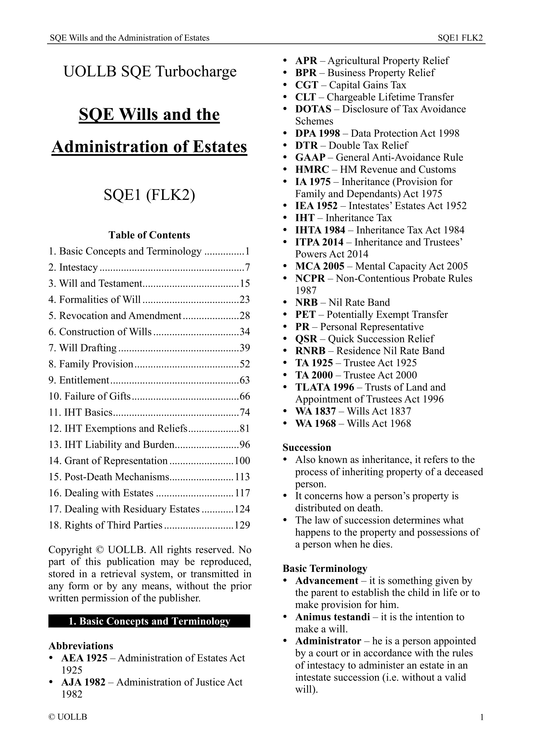
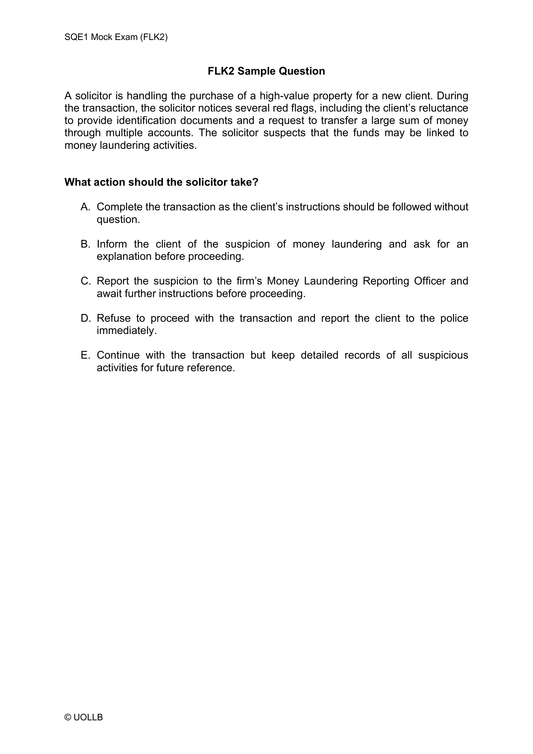
SQE1 consists of 360 single best answer multiple-choice questions, split into two papers of 180 questions each. FLK1 covers business law and practice, dispute resolution, contract, tort, the legal system of England and Wales, constitutional and administrative law, EU law and legal services. FLK2 covers property law and practice, wills and administration of estates, trusts, criminal law and practice, and the legal system and services elements common to both papers.
The multiple-choice format is deceptive. The questions are scenario-based and require you to identify the single best answer from five plausible options. This format is designed to test genuine understanding and application rather than superficial familiarity with the law. Pass marks are set by the SRA on a cohort-by-cohort basis using Angoff standard setting, meaning the pass mark reflects the expected performance of a minimally competent candidate rather than a fixed percentage score. Historically, pass rates have been around 60% for each paper, meaning a meaningful proportion of candidates fail on their first attempt.
SQE2
SQE2 consists of sixteen practical legal skill stations across five skill areas: client interviewing and completion of attendance notes, advocacy, case and matter analysis, legal research and written advice, and legal drafting. Assessments are conducted under controlled conditions, and candidates must demonstrate competence across both contentious and non-contentious legal contexts. The pass mark operates on a competence-based model: candidates either demonstrate sufficient competence or they do not. SQE2 is widely regarded as more demanding in terms of preparation time and investment than SQE1, partly because effective preparation requires realistic practice in conditions that mirror the assessments.
CPQ Assessments
CILEX assessments are modular and take place at CILEX-approved examination centres. Each unit within the CPQ is assessed separately, combining written legal knowledge papers with practical portfolio components that document how the candidate has applied legal principles in their day-to-day work. This integration of academic and practical assessment is quite different from the SQE model, where the work experience and the assessments are formally separate. For many CILEX candidates, the portfolio element is the aspect of the qualification that most closely tracks their actual professional development, making it feel less like an exam to pass and more like a record of genuine competence built over time.
4. Work Experience Requirements
| SQE | CPQ | |
|---|---|---|
| Mandatory Work Experience | 2 years of Qualifying Work Experience (QWE) | 2,300 hours of qualifying legal employment, typically three or more years for part-time workers |
| Where Experience Can Be Gained | Any organisation that provides legal services, including law firms, in-house legal departments, local government, charities, law clinics, and barristers' chambers | Must be in a paid legal employment role within an authorised legal organisation, supporting qualified lawyers |
| Number of Employers | Can be split across up to four different employers | No specified limit on employers, but continuity within a practice area is expected |
| Supervision Requirements | A solicitor or other authorised person must confirm the QWE; no requirement for a formal training contract | Qualifying employment must be supervised by a qualified legal professional who can verify the candidate's development |
| Work-Study Integration | QWE and the SQE assessments are structurally separate; many candidates complete academic preparation first and then accumulate QWE afterwards | Study and qualifying employment are designed to run concurrently throughout the CPQ; assessments are directly linked to work experience via portfolio |
| Sponsorship by Employers | Large law firms and some in-house employers offer training contracts that include SQE preparation funding and structured QWE | Some legal employers actively support CILEX study, particularly regional firms and specialist practices |
The framing of work experience differs meaningfully between the two routes. For SQE candidates, QWE is a requirement to be satisfied, and many candidates approach it as a stage of their qualification journey that follows preparation and assessment. For CILEX candidates, qualifying employment is the ongoing context within which the entire qualification takes place. A CILEX candidate who spends four years qualifying as a conveyancer will, by the time they reach Fellowship, have four years of daily, supervised practice in that area behind them. That depth of practical immersion in a single specialism is one of the things employers in high-volume practice areas consistently value.
5. Cost Comparison
| SQE | CPQ | |
|---|---|---|
| Compulsory Exam Fees (assessments only) | Approximately £5,000 in total (SQE1: ~£2,000; SQE2: ~£3,000) | Varies by stage; total assessment fees across all CPQ stages typically £3,000–£4,500 |
| Prior Degree (if needed) | £27,750–£45,000+ for a three-year English university undergraduate degree, or £12,000–£18,000 for a two-year Graduate Diploma in Law | No degree required at entry; significant potential saving for school leavers |
| Preparation Courses | £4,000–£15,000 for dedicated SQE prep courses; some university-integrated programmes cost more | Tuition through CILEX-approved providers for all CPQ stages approximately £8,000–£12,000 in total |
| Estimated Total (school leaver route) | ~£40,000–£65,000 (including degree, GDL if applicable, prep course, and exam fees) | ~£12,500–£16,000 (all three CPQ stages, exam fees, and tuition) |
| Estimated Total (graduate fast-track) | ~£7,000–£20,000 (exam fees plus prep course, assuming degree already held) | ~£4,000–£8,000 (reduced stages due to exemptions, exam fees, and tuition) |
| Employer Funding | Common at large commercial firms; training contracts often include full SQE funding | Available at some regional and specialist firms; less universal than SQE sponsorship at large commercial firms |
| Opportunity Cost | Many SQE candidates study full-time before entering QWE, foregoing salary during preparation | CILEX candidates are employed throughout; study costs are offset by continuing to earn |
The cost comparison above reinforces why the CILEX route is so attractive to candidates who are not starting with a degree and are not in a position to take on large amounts of debt or forego income. But even for graduates, CILEX can make financial sense. A law graduate who enters a legal job, uses their degree exemptions to skip the Foundation and most of the Advanced stage, and completes the CPQ Professional stage part-time while earning a salary may spend considerably less overall than a law graduate who funds SQE preparation independently without employer support.
6. Salary and Career Prospects
| SQE | CPQ | |
|---|---|---|
| Newly Qualified Salary Range | £30,000–£150,000+ depending on firm size, location, and practice area (NQ salaries at Magic Circle firms significantly exceed the national average) | £28,000–£55,000 at newly qualified level in most practice areas; experienced CILEX Lawyers in specialist areas can earn more |
| Career Ceiling | Very high: partnership, general counsel, judicial appointments, KC at the Bar (via separate routes), international careers | Genuine career ceiling within chosen specialist areas: partnership, firm ownership, judicial appointments; the ceiling rises as CILEX Lawyers gain higher rights |
| Progression to Partnership | Well-established route; partnership timelines vary by firm | Legally available and increasingly common in regional and specialist practices |
| Setting Up in Practice | Solicitors can apply for SRA authorisation to run a firm | CILEX Lawyers can apply for authorisation to operate as a CILEX-regulated firm within their authorised practice areas |
| Judicial Appointments | Eligible; the judiciary draws heavily from the solicitor profession | Eligible; CILEX Lawyers have successfully been appointed to judicial roles |
Salary benchmarking between the two routes is complicated by the fact that the SQE feeds into an enormous variety of practice settings, from publicly funded law centres paying graduate-level salaries to Magic Circle firms where newly qualified solicitors earn six figures. CILEX Lawyers, who tend to concentrate in specialist practice areas and regional firms, generally earn salaries that are competitive within those markets. The honest comparison is less about which route produces higher earners in the abstract and more about which route aligns with the kind of legal career a candidate actually wants to build.
7. Transition between Routes
| Scenario | What Is Possible |
|---|---|
| CILEX Lawyer qualifying as a solicitor | A qualified CILEX Fellow (CILEX Lawyer) can qualify as a solicitor by passing SQE1 (without needing to pass SQE2) and satisfying the QWE requirement. This recognises the extensive practical experience CILEX Lawyers have already accumulated. |
| SQE candidate using CILEX experience as QWE | Experience gained while working as a CILEX Paralegal or CILEX Advanced Paralegal in a qualifying organisation can count towards the SQE QWE requirement. |
| Switching partway through CILEX to SQE | Candidates who have completed some CPQ units can seek exemptions from the SRA based on prior qualifications, though the credit transfer between the two systems is not automatic. |
| Overseas-qualified lawyers and the SQE | The SRA has a separate process for overseas-qualified lawyers; some may be exempt from SQE2 or QWE depending on their jurisdiction and experience. |
The existence of a recognised pathway from CILEX Lawyer to solicitor is important for anyone who worries that choosing CILEX means permanently limiting their options. It does not. What it means is that the journey to the solicitor title, if you later want it, will take somewhat longer via CILEX than it would have done if you had taken the SQE route from the start. For many people in the early stages of their legal career, that is an acceptable trade-off when balanced against the lower cost, the ability to earn while qualifying, and the genuine professional status the CILEX route delivers at each stage.
8. Which Route Suits You
| Candidate Profile | Recommended Route | Reason |
|---|---|---|
| School leaver entering a legal support role | CILEX | No degree barrier; earn while you learn; CPQ begins at Level 3 |
| Law graduate seeking a training contract at a commercial firm | SQE | Degree requirement already met; employer likely to fund SQE preparation; solicitor title expected |
| Non-law graduate without a training contract | SQE (with GDL or self-preparation) or CILEX (via exemptions) | Depends on whether employer sponsorship is available and how quickly they need to qualify |
| Career changer in their 30s or 40s already working in law | CILEX | Work-integrated model suits career changers; CPQ can often be completed faster via exemptions |
| Paralegal who wants to qualify without stopping work | CILEX | CPQ designed specifically for this profile |
| Candidate aiming for a specific specialism (e.g. conveyancing, family, wills) | CILEX | Specialist training from an early stage; deep expertise valued by employers in those sectors |
| Candidate unsure of specialism or wanting broad career options | SQE | Generalist qualification keeps all doors open post-qualification |
| Candidate with strong academic credentials and access to funding | SQE | Centralised standardised route; widely recognised; employer sponsorship often available |
| Candidate focused on minimising overall cost and debt | CILEX | Total cost significantly lower, especially for school leavers and those without employer sponsorship |
The Question of Prestige
It would be dishonest to ignore the question of prestige entirely. For much of the history of the two qualifications, the solicitor title was treated as more prestigious, and the CILEX route was described, sometimes by people who should have known better, as a lesser alternative. That framing was always somewhat unfair, and it has become increasingly inaccurate as the legal profession has modernised.
Under the Legal Services Act 2007, CILEX Lawyers hold full and equal statutory status to solicitors within their authorised practice areas. They can become partners in law firms, own and operate authorised legal practices, acquire Higher Rights of Audience, and apply for judicial appointments. The legal architecture treats them as equivalent professionals in the areas where they are qualified to practise. The question is not whether a CILEX Lawyer is a real lawyer but whether the practice rights and market recognition attached to the CILEX title serve a particular candidate's career goals as well as those attached to the solicitor title.
In high-volume, specialist practice areas, the CILEX title is extremely well understood by employers and clients. In large commercial firms, in-house legal departments at multinational corporations, and international legal markets, the solicitor title is more universally expected. A thoughtful answer to the SQE versus CILEX question has to acknowledge that reality without caricaturing either option.
The Bottom Line
The SQE and the CILEX CPQ are both rigorous, respected, and recognised qualification routes into the English and Welsh legal profession. They are not equivalent in what they produce or who they are designed for, and pretending otherwise helps no one.
The SQE is the right choice if you already hold or are committed to obtaining a degree, you are aiming for a career in commercial or private practice where the solicitor title is expected, you have access to employer funding or are prepared to invest significantly in preparation, or you want the broadest possible range of post-qualification options. It is demanding, standardised, and opens doors across the full spectrum of legal practice.
The CILEX CPQ is the right choice if you do not have a degree and do not want to obtain one before starting your legal career, you are already working in a legal role and want to qualify around that work, you want to become a specialist in a specific area of law from an early stage, you are managing significant financial constraints and need to minimise the cost of qualification, or you value practical, work-integrated learning over classroom preparation for centralised exams.
Neither route is easy, and neither route should be chosen carelessly. The legal profession is competitive, demanding, and rewards people who make deliberate decisions about their own development. The good news is that both the SQE and the CILEX CPQ are genuine routes to a genuine legal career, and the existence of a pathway from one to the other means that a decision made today does not have to be irreversible tomorrow. What matters most is understanding where you are, where you want to go, and which route actually gets you there.